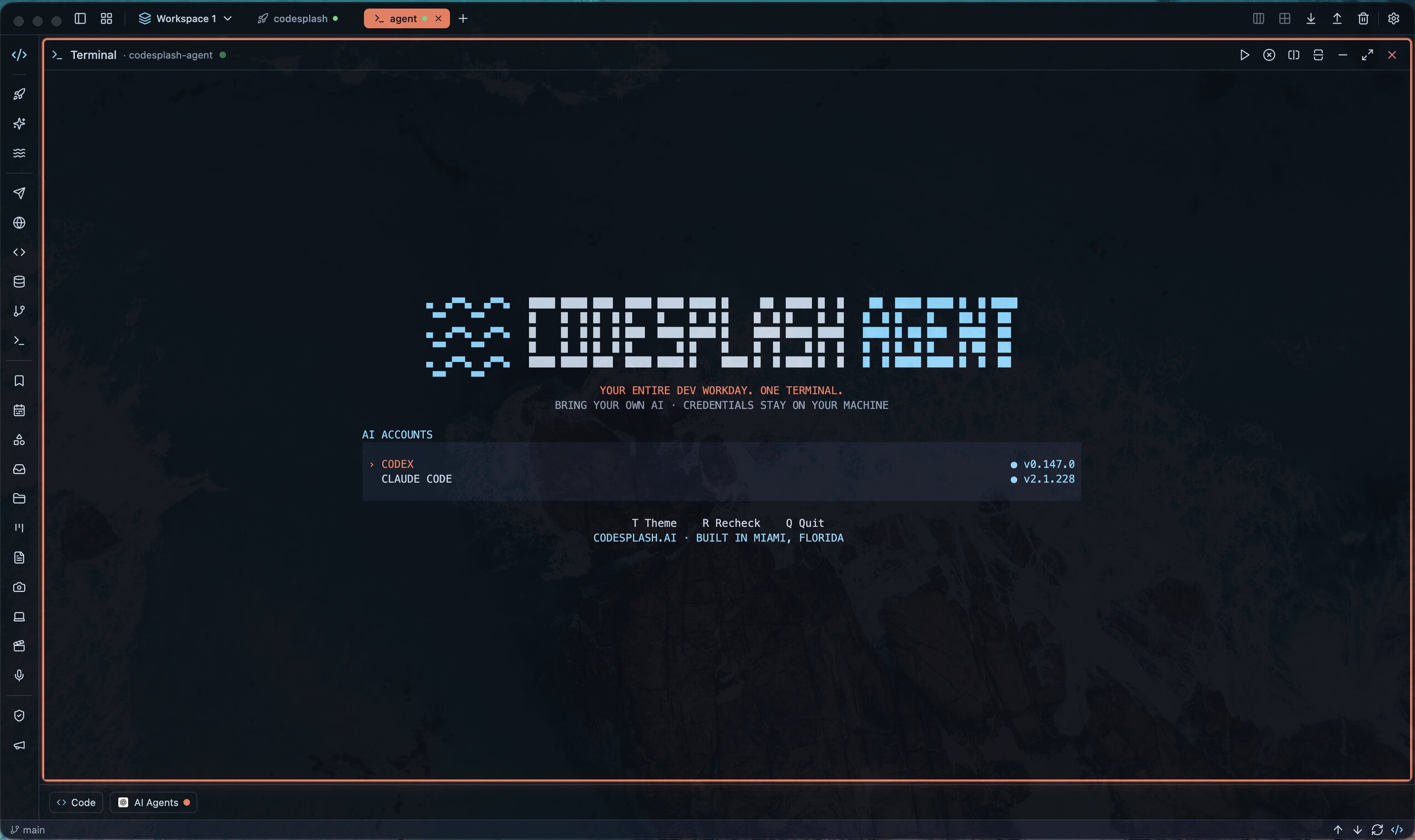
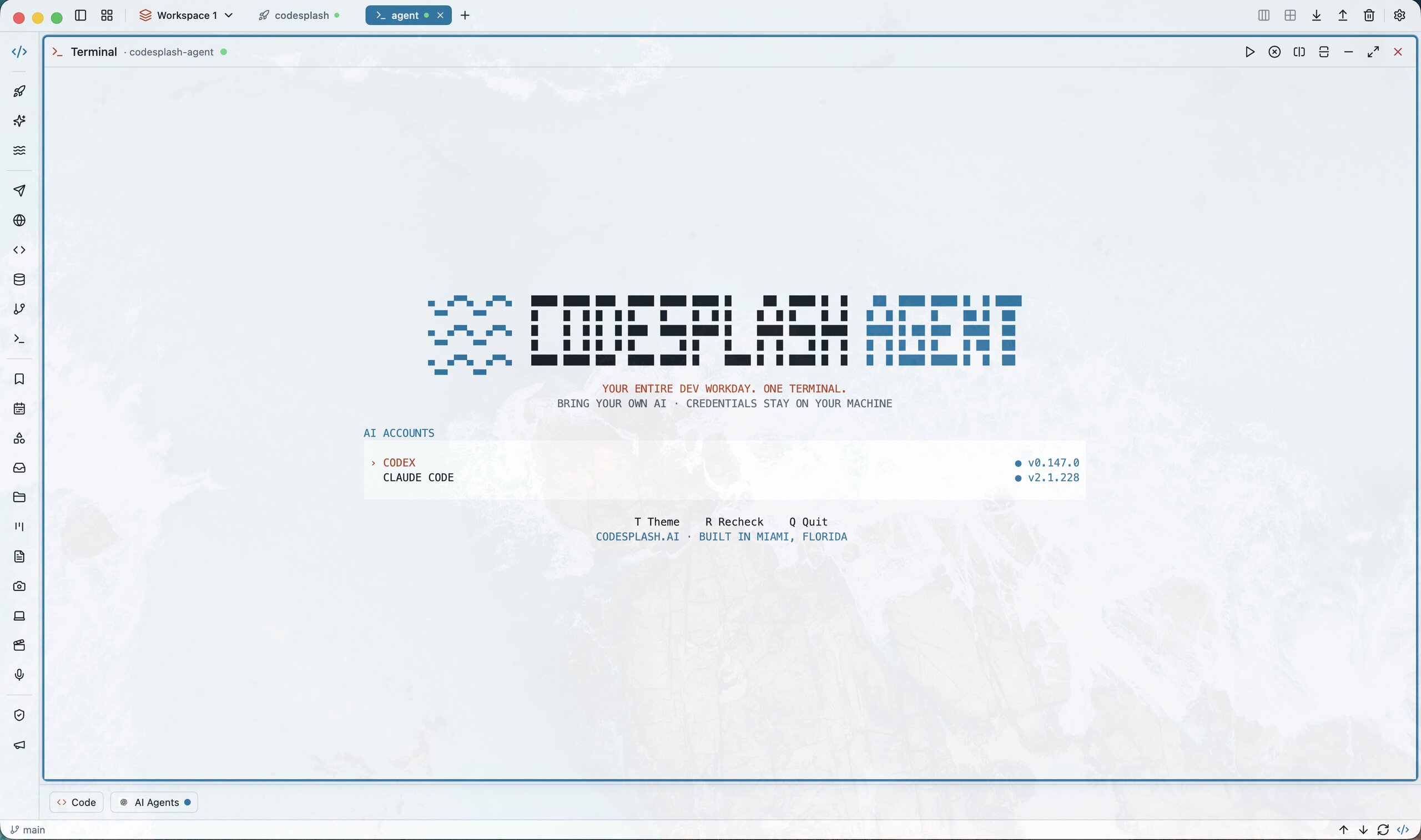
CodeSplash AI is your entire dev workday on one desktop. CodeSplash Agent is the same idea for people who live in one terminal.
It is an agent harness for the coding agents you already pay for. Codex runs natively: streamed responses, thinking, tool activity, live diffs, plans, interactive approvals, and resumable sessions, all rendered over the official codex app-server protocol. Claude Code runs through the official CLI: one keypress hands your real terminal to claude, and the harness restores itself when you leave.
A harness, not another agent
Plenty of tools want to sit between you and your AI subscriptions. Most of them do it by reimplementing provider auth, proxying API calls, or reading credential stores. I did not want to build that, and I would not want to run it either.
So CodeSplash Agent draws a hard line:
- It has no model loop and no tools of its own. Codex and Claude Code keep owning their agent loops. The harness renders and steers them.
- It never touches credentials. No provider OAuth reimplementation, no reading the Claude or Codex credential stores, no API keys, no proxying. You log in to the official CLIs the way you always have.
- There is nothing else to sign up for. No CodeSplash account, no telemetry, no paid tier. Uninstalling is deletion, because the app owns nothing of yours.
What ships in 0.1
The first release is a working daily driver for Codex plus a clean bridge to Claude Code:
- Native Codex sessions. Streamed turns with a model picker, live diffs and plan updates while the agent works, keyboard approvals, interrupt, crash recovery, reconnect, and resume. The status line tracks context left and your account rate limits.
- Claude Code handoff. The harness hands over your real terminal, forwards signals, and restores terminal state on exit. Claude Code turns happen in the official interface, and their output is never recorded.
- Sessions that respect you. History is local and normalized, with credential-shaped content stripped at source and files written
0600.--no-historywrites nothing at all. - Conservative safety defaults. Codex runs in a workspace-write sandbox with interactive approvals. Full access requires a flag plus a typed confirmation on every session, and resume never silently escalates policy.
Install it
# Homebrew (macOS and Linux)
brew install codesplash-ai/tap/codesplash-agent

# npm (requires Bun 1.3+)
npm i -g codesplash-agent
Standalone signed binaries are on GitHub releases if you want no runtime at all. You will also need the engines themselves: the Codex CLI at the pinned version (npm i -g @openai/codex@0.147.0) and/or Claude Code. Run codesplash --doctor to confirm everything is detected.
Where it is today
This is a v0.x alpha, and I would rather say that plainly than pretend otherwise. macOS on Apple Silicon is the primary target; macOS x64 and Linux are CI-gated, and Windows is experimental. Claude Code turns do not appear inside the harness transcript yet. Only targets that pass real launch smoke tests get advertised, and every release is a versioned, checksummed artifact you can roll back.
The product page is at /products#agent, the full guide is at /docs/agent, and the code is source-available on GitHub under the Business Source License 1.1, converting to Apache-2.0 in 2030.
If you spend your day in a terminal next to Codex or Claude Code, I built this for you. Tell me what the harness should learn next.